A software developer who is particularly good at turning strong design and business requirements into finished products.
Mimos AI
- My role
- Designer and sole developer, at Lumios Digital.
- What I delivered
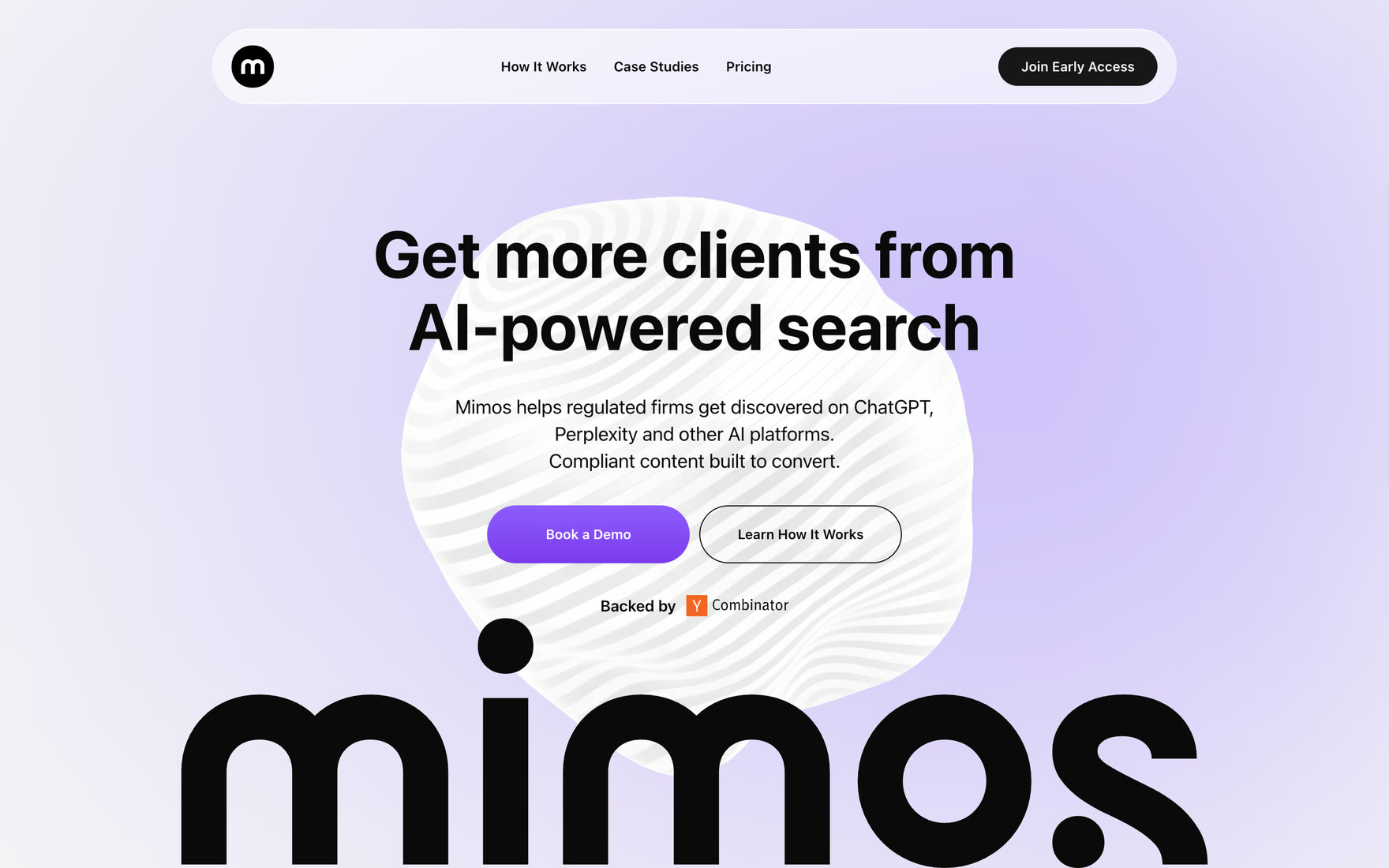
- A Next.js 15 launch site on the App Router with React 19, TypeScript, Tailwind, Radix primitives, Framer Motion, a Spline 3D hero and Supabase: separate desktop and mobile compositions, a qualifying early access funnel and an insert-only row level security policy, written up for handover.
- Why it mattered
- The product was pre-launch, with no demo and no customers to quote, so the site itself had to read as evidence. The waitlist form asks about budget, which costs some signups and buys a ranked list of conversations instead of the longest possible list.
- Current status
- Launched in 2025. Mimos AI has since redesigned, so the current trymimos.com is not this work. The source for the original stays public.
Scope
Mimos AI helps businesses get found on AI platforms: visibility in AI search, with tracking, compliance and conversion around it. I designed and built their launch site at Lumios Digital, a single page product landing with an early access funnel behind it.
Next.js 15 on the App Router, React 19, TypeScript, Tailwind, Radix primitives, Framer Motion for movement, Spline for the 3D, and Supabase for the data.
This is the site as designed and launched in 2025. Mimos AI has since moved to a newer design, so the current trymimos.com is not this work.
Selling something nobody can try yet
Every other project here has a thing to show: a product to photograph, an island to visit, a catalogue to browse. Mimos AI had none of that. The product was pre-launch, so there was no demo, no screenshots of a real dashboard, no customers to quote.
Which puts unusual weight on the site itself. When the pitch is that you understand how visibility works in the AI era, a site that looks ordinary undermines the claim before a word is read. The page had to feel like evidence rather than description, which is why it carries a 3D hero and real motion rather than a stack of feature cards.
Two builds, not one responsive one
The desktop and mobile experiences are separate compositions, switched by a media-query component rather than adapted with CSS alone.
That is a deliberate cost. Responsive CSS is less code and usually the right answer, but not when the centrepiece is a hosted 3D scene: adapting it down means every phone still pays for something built for a large screen and a pointer. Building the mobile screen separately meant it could be designed for a phone rather than degraded into one.

A funnel that qualifies
The early access form asks for more than an email. Name, company, monthly budget and notes, validated with Zod on the way in and again inside a server action before anything is written.
Asking about budget on a waitlist form costs some signups, which is the point. A pre-launch startup with limited time does not need the longest possible list, it needs to know which conversations are worth having first. The form is a qualification step wearing the costume of a signup.
Where the security actually is
Supabase's anonymous key is public by design; it ships in the browser bundle and there is no hiding it. People new to the platform treat that key as the protection, which it is not.
The boundary is the row level security policy. Here it permits inserts and nothing else, so the key in the wild can add a lead and can never read the list of them. The schema and its policies were written up as a handover document for the client rather than left in my head, since the point of a launch site is that somebody else can own it afterwards.
Small things that matter later
The Supabase client falls back to a placeholder when environment variables are missing, so a build never fails on absent config. It is four lines and it is the difference between a deploy pipeline that works for whoever inherits the project and one that fails mysteriously the first time somebody clones it.
Status
Designed, built and launched in 2025 at Lumios Digital. The company has since redesigned the site, which is the normal life of a startup landing page. The source for the original remains public.